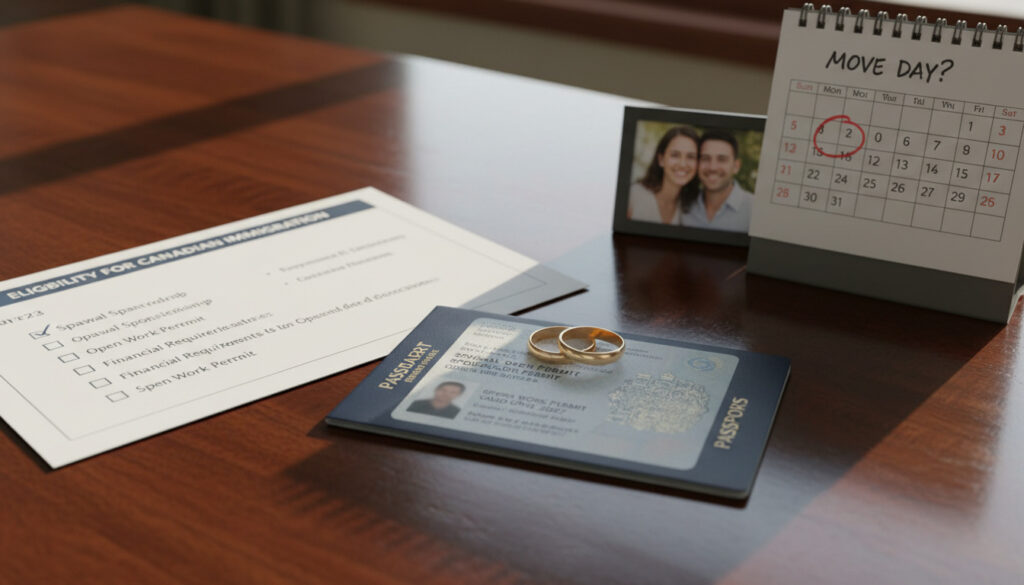
Spousal Open Work Permit – Eligibility Guide 2025
A spousal open work permit allows eligible spouses and common-law partners of certain foreign workers, international students, and permanent residence applicants to accept employment with any Canadian employer without requiring a Labour Market Impact Assessment. Since early 2024, Immigration, Refugees and Citizenship Canada has significantly tightened eligibility criteria, restricting access primarily to partners of high-skilled workers and graduate-level students.
The policy shifts represent a fundamental contraction of Canada’s approach to family accompaniment for temporary residents. Where previously spouses of most full-time students and workers could obtain unrestricted work authorization, current rules impose specific occupational classifications and program duration thresholds that exclude many undergraduate students and low-wage workers from sponsoring their partners.
Understanding these parameters proves essential for families navigating Canada’s immigration system, as application errors or eligibility misinterpretations can result in refusals or prolonged processing delays. The following sections outline current requirements, documentation standards, and procedural pathways based on official Immigration, Refugees and Citizenship Canada directives.
What Is a Spousal Open Work Permit?
Core Definition
Unrestricted employment authorization issued to spouses, common-law partners, or conjugal partners of qualifying temporary residents or permanent residence applicants.
Primary Advantage
Employment flexibility across any sector or employer without LMIA constraints or occupation-specific restrictions.
Duration
Validity period corresponds to the principal applicant’s study permit, work permit, or permanent residence application status.
2024-2025 Constraint
Eligibility now limited to specific high-skill occupation codes and graduate academic programs.
- Eligibility determinations now hinge entirely on the principal applicant’s occupation TEER level or academic program standing.
- Foreign workers must hold positions classified as TEER 0, 1, or select TEER 2/3 categories to qualify their spouses.
- A strict 16-month remaining validity requirement applies to principal worker permits at the time of spousal application receipt.
- Undergraduate and college diploma students lost spousal sponsorship privileges effective March 19, 2024.
- Master’s degree programs must extend sixteen months or longer to qualify accompanying spouses.
- In-Canada family class sponsorship applicants retain open work permit access under extended public policy provisions.
- Applications submitted before policy cutoff dates may qualify under transitional provisions using previous eligibility standards.
| Fact | Details |
|---|---|
| Base Application Fee | CAD $155 |
| Open Work Permit Holder Fee | CAD $100 |
| Biometrics Collection | CAD $85 |
| Standard Processing Window | 3 to 6 months (variable by visa office) |
| Worker TEER Classification | 0, 1, or select 2/3 occupations |
| Student Program Requirements | Master’s (16+ months), Doctoral, or eligible professional degrees |
| Application Portal | IRCC online system exclusively |
| Quebec-Specific Requirement | CAQ (Certificate of Acceptance) necessary for provincial employment |
Who Is Eligible for a Spousal Open Work Permit?
Eligibility pathways diverge significantly based on whether the principal applicant holds temporary worker status, student authorization, or has submitted an in-Canada permanent residence sponsorship application. Each category carries distinct qualification thresholds established through regulatory amendments effective 2024 and 2025.
Spouses of High-Skilled Foreign Workers
Foreign workers may sponsor spousal open work permits only when employed in occupations classified under TEER 0 (management), TEER 1 (professional), or specific TEER 2/3 (technical and skilled trades) categories. The principal worker must possess at least sixteen months of remaining work permit validity at the time of application receipt. Additionally, the couple must demonstrate genuine relationship status, and the spouse must maintain valid temporary status, maintained status, or restoration eligibility within Canada.
Spouses of International Students
International students must hold valid study permits and maintain full-time enrollment in qualifying programs. Eligible institutions include master’s degree programs lasting sixteen months or longer, doctoral programs, or eligible professional degrees such as medicine, veterinary medicine, dentistry, law, or optometry. Spouses of students enrolled in undergraduate, postgraduate certificate, or diploma programs no longer qualify under regulations implemented March 19, 2024.
In-Canada Permanent Residence Sponsorship
Sponsored spouses and common-law partners residing in Canada under the family class sponsorship program remain eligible under extended public policy provisions. Applicants must possess an Acknowledgement of Receipt for their permanent residence application and physically cohabitate with their sponsor. Dependent children accompanying such applicants may also obtain open work permits provided they maintain genuine familial relationships and shared residency.
Exclusions and Limited Exceptions
Foreign workers classified in TEER 4 or 5 occupations, along with dependent children of temporary foreign workers, generally do not qualify for open work permits. However, two significant exceptions persist: workers arriving under Free Trade Agreement provisions retain spousal work permit privileges regardless of occupation level, and Specific Instructions Program participants become eligible at any TEER classification effective March 23, 2026, provided they reside in Canada.
The principal worker must demonstrate at least sixteen months of remaining work permit validity when immigration officials receive the spousal application. Applications submitted when less time remains face automatic refusal.
How to Apply for a Spousal Open Work Permit
All applications must proceed through the Immigration, Refugees and Citizenship Canada online portal, regardless of whether the applicant resides inside or outside Canada. The digital submission system requires complete document uploads and fee payment before processing begins.
Application Location and Status Requirements
Applicants inside Canada may submit if they hold valid temporary resident status, maintained status pending a previous application decision, or eligibility for status restoration. Those applying from outside Canada follow standard temporary residence procedures through their local visa office. The online portal accommodates both pathways through distinct intake forms.
Relationship Documentation Standards
Officers require compelling evidence of genuine, ongoing relationships. Married couples must submit official marriage certificates. Common-law partners must provide a statutory declaration attesting to at least twelve months of continuous cohabitation, supplemented by shared residential leases, utility accounts, or financial documentation. Photographic evidence, correspondence history, and third-party affidavits strengthen applications facing scrutiny.
Administrative Requirements and Quebec-Specific Protocols
Most applicants must provide biometrics (fingerprints and photograph) at a cost of CAD $85. Those intending to work in Quebec must obtain a Certificate of Acceptance (CAQ) before commencing employment, a provincial requirement distinct from federal permit issuance. Applicants should familiarize themselves with the Norme Du Travail Quebec – What Every Worker Should Know to understand provincial labor standards before arrival.
Processing Times, Costs, and Post-Application Rights
Understanding fee structures, processing timelines, and interim work rights helps applicants plan their financial and professional transitions. While government fees remain standardized, processing experiences vary considerably based on application volume and visa office capacity.
Although IRCC indicates typical processing spans three to six months for online applications, actual timelines fluctuate significantly depending on specific visa office workloads, completeness of initial submissions, and security screening complexity.
Government Fees and Processing Duration
Total mandatory government fees include CAD $155 for the work permit application, CAD $100 for the open work permit holder privilege, and CAD $85 for biometrics collection. Processing times generally range from three to six months for complete applications, though inside-Canada submissions sometimes process faster than overseas applications.
Maintained Status and Interim Work Authorization
Applicants who submit spousal open work permit applications before their current status expires receive “maintained status” (previously implied status), allowing them to remain in Canada legally during processing. However, work authorization during this interim period depends entirely on previous status: only those who held valid work permits before applying may continue working. Individuals who previously held visitor status cannot commence employment until receiving the new permit. For more information, consult El repartiment de Top Gun 2.
Extensions and Renewal Procedures
Applicants must submit extension requests before current permits expire to maintain legal status. Extension eligibility follows the same criteria as initial applications, including the TEER classification and 16-month validity requirements for worker-sponsored permits. Those who submitted initial applications before March 19, 2024, may qualify for transitional provisions allowing extension under previous eligibility standards.
Retain copies of all relationship documentation submitted with initial applications. Extensions often require refreshed evidence of ongoing cohabitation and relationship continuity, particularly for common-law partnerships.
How Spousal Open Work Permit Rules Changed: 2024-2026
- : Immigration officials initially previewed forthcoming restrictions on student spousal work permits, signaling the policy pivot away from undergraduate accompaniment.
- : Regulations formally limited student-sponsored spousal permits to master’s (minimum sixteen months), doctoral, and eligible professional degree programs, eliminating undergraduate and college diploma pathways.
- : Worker-sponsored permits restricted to TEER 0, 1, and select TEER 2/3 occupations; sixteen-month remaining validity rule implemented; dependent children of workers excluded from open work permit eligibility. Projections indicate approximately one hundred thousand fewer spousal permits over three years.
- : Specific Instructions Program workers become eligible for spousal permits regardless of TEER classification, provided they reside in Canada.
Established Rules Versus Application Uncertainties
| Definitive Regulatory Requirements | Variable or Unclear Factors |
|---|---|
| TEER 0, 1, or select 2/3 occupation requirement for workers | Specific NOC codes designated as eligible TEER 2/3 without official exhaustive list |
| Sixteen-month minimum remaining work permit validity | Processing time predictions for specific visa offices or complex cases |
| Sixteen-month minimum duration for eligible master’s programs | Discretionary factors in relationship genuineness assessments |
| Mandatory online application submission | Future policy adjustments beyond 2026 implementation dates |
| Biometrics requirement for most applicants | Medical examination triggers based on occupation or origin country changes |
Policy Context: Why Canada Restricted Spousal Work Access
The 2024-2025 eligibility contractions reflect broader Canadian government efforts to align temporary resident volumes with national absorption capacity, particularly regarding housing availability and labor market conditions. By restricting spousal work permits to high-skill workers and graduate students, policy makers aim to concentrate family accompaniment within economic categories demonstrating higher earnings potential and longer-term settlement likelihood.
These measures also respond to sectoral labor market protection concerns, ensuring that low-wage employment categories do not become dependency pathways for accompanying family members who might then enter competitive labor markets without direct economic necessity. The projected reduction of one hundred thousand spousal permits over three years represents a significant structural shift in Canada’s temporary immigration framework.
For those exploring alternative economic pathways, resources such as the Business for Sale Mississauga – 2025 Listings and Buying Guide illustrate entrepreneurship options available to permanent residents and citizens, highlighting the economic integration avenues that spousal work permit holders may eventually pursue after status transition.
Official Sources and Regulatory Authority
Eligibility has been significantly restricted since 2024, with major changes effective March 19, 2024, and January 21, 2025, primarily limiting access to high-skilled workers (TEER 0, 1, or select TEER 2/3 occupations), master’s/doctoral students, and those on PR pathways.
Immigration, Refugees and Citizenship Canada Policy Directives
The principal worker must have at least 16 months valid work authorization remaining at the spouse’s application receipt date, representing a new temporal constraint on eligibility determinations.
Key Considerations for Prospective Applicants
Success in obtaining spousal open work permits now requires precise alignment with TEER classifications, program duration minimums, and strict validity timelines. Applicants must prepare comprehensive relationship documentation and anticipate processing windows of several months while understanding that maintained status does not automatically confer work rights. Those intending to settle in Quebec should additionally consult the Norme Du Travail Quebec – What Every Worker Should Know to ensure compliance with provincial employment standards upon arrival.
Frequently Asked Questions
Can dependent children of foreign workers obtain open work permits?
No. Under regulations effective January 21, 2025, dependent children of temporary foreign workers are generally ineligible for open work permits unless accompanying a principal applicant under the in-Canada PR sponsorship pathway with a valid AOR.
Do I need a job offer before applying for a spousal open work permit?
No. As an open work permit, this authorization does not require a pre-existing job offer, LMIA, or employer sponsorship. The permit holder may work for any eligible Canadian employer upon approval.
Can I study while holding a spousal open work permit?
Yes. Open work permit holders may engage in part-time or full-time study without requiring a separate study permit, provided the study duration does not exceed the work permit validity period.
What constitutes valid proof of common-law partnership?
Applicants must provide a statutory declaration of common-law union plus evidence of twelve months continuous cohabitation, including shared lease agreements, utility bills, bank statements, or government documents showing the same residential address.
Can I apply for a spousal open work permit at a Canadian port of entry?
No. Applications must be submitted online through the IRCC portal. Port of entry applications are not available for initial spousal open work permit requests.
What happens if my spouse’s work permit expires in four months?
The spousal application will face refusal. The principal worker must hold at least sixteen months of remaining validity when IRCC receives the application. Consider extending the principal worker’s status first.
Are biometrics always required for spousal open work permits?
Most applicants aged fourteen to seventy-nine must provide fingerprints and photographs. However, certain exemptions apply based on previous biometrics submissions or specific nationality-based exemptions.
More related posts
 Christina Aguilera: Kids, Weight Loss, and Net Worth Facts
 Silver Spot Price Canada: Live CAD Rate & Foreca t
 Prayer Times in Mississauga Canada: Fajr, Zuhr, Asr, Maghrib, Isha
 Tyler Hynes: Facts, Rumors, and Career
 Canada Pension Plan May 2025 Payments – May 28 Date and $1,365 Max
 Cam Newton: Biography, Stats, Net Worth, and Latest News
 Map of United States – Printable Labeled and Blank Versions
 Bella Hadid: Health, Relationships, Career, and Net Worth