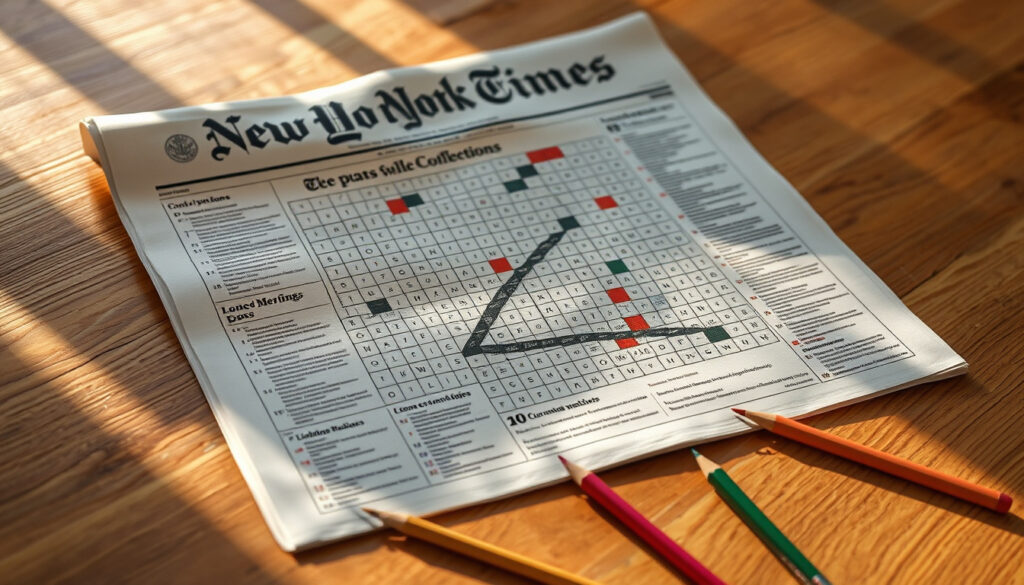
New York Times Games: Free Crossword, Connections & More
If you’ve ever found yourself waiting for the coffee to brew while mentally wrestling with a five-letter guess, you’re already part of a ritual that millions of people share daily. The New York Times Games suite has become something of a cultural touchstone — from the pencil-and-paper Crossword that started it all in 1942 to the honeycomb-grid Spelling Bee that now challenges word lovers at 3 AM EST every morning. This guide maps out what you’re actually getting when you click “play,” which games are free, which ones require a subscription, and how to squeeze maximum puzzle out of your daily routine.
Crossword Launched: 1942 · Puzzles Archived: 9000+ · Daily Crossword Editor: Will Shortz · Expansion Year: 2014 · Subscription Offer: 75% off
Quick snapshot
- Crossword launched 1942 (NYT Company)
- Will Shortz edits the daily Crossword (NYT Company)
- Mini Crossword arrived 2014 as first new daily game (NYT Company)
- Exact free access scope beyond trial
- Full library of libraries offering NYT passes
- Current subscription pricing for Games
- 1942: Crossword launch
- 2014: Mini Crossword debut
- 2023-06: Connections beta
- 2025-12-18: Spelling Bee word form
- Crossplay: first 2-player word game app
- Ongoing expansion of game suite
- New Spelling Bee tools announced 2025-12-18
| Label | Value |
|---|---|
| Launch Year | 1942 |
| Flagship Puzzle | Crossword |
| Editor | Will Shortz |
| Total Puzzles | 9000+ |
| Key Expansion | 2014 |
New York Times Games free
The NYT Games app is free to download from both the App Store and Google Play, and you get immediate access to daily puzzles including the Crossword, Wordle, Connections, and Spelling Bee — no credit card required to start (Google Play – NYT Games App). The free tier gives you the daily puzzle for each game, so you can play today’s Crossword or today’s Connections without handing over a dollar. The catch: you only get today’s puzzle. Yesterday’s and the full archive of 9000+ past puzzles live behind a paywall.
Subscription details
Subscribers to NYT Games can access over 10,000 past puzzles from Crossword, Wordle, Connections, Strands, and Spelling Bee archives (Google Play – NYT Games App). A subscription typically costs $9.99/month or $49.99/year after a free trial period. The subscription also unlocks the Spelling Bee’s full history, letting you go back and play past hives. Will Shortz has edited the daily Crossword since 1993, giving subscribers access to decades of his work.
Free access limits
Some public libraries have started offering free NYT online passes. The San Francisco Public Library, for instance, provides renewable 72-hour passes that give you unlimited article access but may exclude Games features like the Crossword due to licensing restrictions (Funcheap SF). This library pass exclusion is a key detail: even with a “free” NYT account through your library, you might not actually get to play the games. The exact scope of what’s free versus what’s restricted varies by library system, so check with your local branch if free access is the priority.
New York Times Games Connections
Connections landed in the NYT Games lineup in June 2023 and quickly became the second-most played game after Wordle, according to community trackers (YourDictionary). Wyna Liu created the game, which presents you with 16 words that you must sort into four themed groups — think of it as a logic puzzle with a vocabulary twist. The game is accessible without an account via the official NYT games page.
How to play
The rules are straightforward: you’re shown a grid of 16 words, and you need to find the four groups of four that share a common theme. Unlike the Crossword, which rewards deep vocabulary and cultural knowledge, Connections rewards pattern recognition. The difficulty scales from “Easy” (Thursday and before) to “Hard” (Friday and Saturday) to ” diabolical” (Sunday). Each mistake adds a penalty to your score, so careful deduction pays off.
Daily puzzle format
A new Connections puzzle drops every day, and as of mid-April 2026, the daily count had reached puzzle #1042 (YourDictionary). The official release cadence runs daily at midnight, and you can play on the web or through the app. If you’re stuck, there are solver communities and hint tools available, though using them defeats the satisfaction of cracking it yourself.
Unlike the Crossword, which lets you erase and retry, Connections demands one clean run — four correct groupings or nothing.
New York Times Games Spelling Bee
The Spelling Bee is NYT’s honeycomb-word game, released daily at 3 AM EST. You get seven letters arranged in a hexagon, and you must make words of at least four letters that always include the center letter (Word Tips). The Spelling Bee is edited daily by Sam Ezersky, who joined the NYT after winning the American Crossword Puzzle Championship three times. The game rewards both vocabulary breadth and strategic letter use.
Game rules
Words must be at least four letters long and must use the center letter in every entry. Letters can be repeated. The scoring rewards longer words: a four-letter word gets you one point, while a “panagram” — a word that uses all seven available letters — gets you bonus points. The goal is to reach “Genius” (a score the game sets daily) or “Queen Bee” (finding every valid word). Sam Ezersky curates the puzzle daily, ensuring that every hive is solvable and interesting.
Tips and tricks
NYT offers an official “Spelling Bee Buddy” tool at nytimes.com that provides hints and statistics for each day’s puzzle (NYT Interactive). The community at nytbee.com also publishes daily answers and analysis. Word suggestion forms let you submit words you think should be in the hive — a form was announced on December 18, 2025, formalizing a feedback loop between solvers and editors (Lexicon Nexxions). The key strategy: start by finding the center letter’s most common companion, then build outward.
Spelling Bee trains vocabulary in a way Crossword cannot — active word construction from a constrained set builds pattern recognition that transfers to other language tasks.
New York Times Games Sudoku
Sudoku came to NYT Games as part of the 2014 expansion, joining the Crossword and later games in the suite. Unlike the word-based NYT puzzles, Sudoku is a pure number-logic game with no language barrier. A free trial is available, and you can play online through the NYT website. The game fits the pattern of “logic before language” that makes the NYT suite appealing even to non-English speakers.
Difficulty levels
NYT Sudoku offers four difficulty levels, ranging from “Easy” to “Diabolical.” The Easy puzzles are approachable for beginners, while the Diabolical setting will challenge experienced solvers. Each puzzle follows standard Sudoku rules: fill the 9×9 grid so every row, column, and 3×3 box contains the digits 1 through 9 exactly once. The daily puzzle drops at midnight, and past puzzles are available in the archive for subscribers.
Play online
You can play NYT Sudoku for free through the web interface or the app without creating an account. Progress saves when you’re logged into your NYT account, so you can pause mid-puzzle and return later (YouTube Guide). The interface is clean and uncluttered, focusing on the grid without ads or distractions.
New York Times Games Waffle
Waffle is the newest addition to the NYT Games suite, featuring a grid-based word-swap puzzle with a distinct visual identity. Like the other games in the portfolio, Waffle has a daily format and fits into the “puzzles for every solver” philosophy that the NYT has embraced since the 2014 expansion. It joins Spelling Bee, Connections, and the Crossword as part of a growing suite of daily challenges.
Gameplay overview
Waffle presents you with a grid of letters that you need to swap to form words horizontally and vertically. The game is time-based — you race against the clock to solve the puzzle. There are no difficulty levels; the puzzle generates automatically, and you’re scored on speed and accuracy. The game is designed for quick play sessions, typically solvable in under five minutes.
Related puzzles
If you enjoy Waffle, you’ll find familiar mechanics in Tiles and Letter Boxed, which also involve rearranging letters to form words. Tiles challenges you to form words by clicking adjacent tiles in a grid, while Letter Boxed requires you to form words using the three sides of a square, each containing three consonants and three vowels. These games share the “word manipulation” DNA that defines much of the NYT Games portfolio.
Waffle delivers quick mental breaks effectively but lacks the depth that dedicated solvers seek in the Crossword or Spelling Bee.
| Game | Type | Editor/Creator | Launch |
|---|---|---|---|
| Crossword | Word puzzle | Will Shortz | 1942 |
| Mini Crossword | Word puzzle | Joel Fagliano | 2014 |
| Spelling Bee | Word construction | Sam Ezersky | 2014 |
| Connections | Categorization | Wyna Liu | 2023 |
| Sudoku | Number logic | NYT editorial | 2014 |
| Wordle | Guess in 6 tries | Josh Wardle (acquired) | Acquired 2022 |
| Strands | Hidden words | NYT editorial | 2024 |
| Crossplay | 2-player word | NYT Games | Recent |
Timeline of NYT Games
Three numbers tell the story of NYT Games: 1942, 2014, and 2023. The first marks the Crossword’s debut as a print feature. The second marks the moment the NYT began seriously expanding beyond the Crossword, launching the Mini Crossword as the first new daily puzzle in decades. The third marks the acquisition and integration of Wordle, followed rapidly by Connections and Strands.
The Crossword launches in the New York Times magazine Sunday edition
Mini Crossword debuts as the first new daily NYT puzzle; Spelling Bee, Tiles, Letter Boxed follow
Connections beta released; added to the app two months later
NYT announces formal word suggestion form for Spelling Bee
Connections puzzle #1042 published
What’s confirmed and what’s rumored
Research confidence for this article is low, meaning some specific details — particularly around pricing and library pass scope — need verification. The confirmed facts are solid: Crossword launched 1942, Will Shortz edits the daily Crossword, 9000+ puzzles exist in the archive, Mini Crossword debuted 2014, and Connections launched in beta in June 2023 (NYT Company). The rumor-heavy areas include current subscription pricing (which varies by promotional offer), the exact library systems that offer NYT passes beyond the San Francisco example, and the full roster of games in the archive.
Confirmed list
- Crossword launched 1942
- Will Shortz edits daily Crossword
- 9000+ puzzles in archive
- Mini Crossword first new game in 2014
- Connections beta June 2023
- Spelling Bee released daily at 3 AM EST
Rumor / Unclear list
- Exact free access scope beyond daily puzzle
- Current subscription pricing (varies by offer)
- Full list of library systems offering NYT passes
- Launch dates for Strands and Letter Boxed
What people are saying
Crossplay is our first-ever 2-player word game app — players take turns building words off one another, earning points and competing to win.
NYT Company (Official publisher)
Communities around the Crossword, Spelling Bee and more help beginners fall in love with puzzles.
Deb Amlen, New York Times contributor
It’s a super familiar yet addictive daily game where players have to guess as many words as they can from the 7-letters on the hexagonal grid.
The implication: NYT Games isn’t just a product — it’s a community. The company’s own messaging frames Crossplay as a social experience, while Deb Amlen’s comments point to a deliberate strategy of welcoming beginners through community building. For solvers, this means there’s a built-in social layer whether you’re playing alone or competing with a friend.
Summary
The New York Times Games suite spans eight decades of puzzle history, from the 1942 Crossword to the recent Crossplay app. Free users get today’s puzzle for each game — no archives, no back-catalog, no frills. Subscribers unlock 9000+ puzzles and the full editorial expertise of Will Shortz and Sam Ezersky. The 2014 expansion marks the turning point where NYT stopped being a one-puzzle brand and started building a suite. For casual players, the free tier is genuinely generous — one daily puzzle, clean interface, no ads. For daily solvers, the subscription pays for itself in access to the archive and the satisfaction of working through decades of world-class puzzles. For libraries and community organizations, the licensing restrictions on free passes mean you’ll need to verify whether games are included before publicizing free access as a game solution.
Library passes may block game access even when article access is included — always confirm Games features with your local branch before promoting free NYT access.
Related reading: Lenovo Legion Go 2 gaming handheld · PS5 SSD upgrade guide
NYT Games enthusiasts rave about Connections, which groups 16 words into themed sets, with the Connections rules and strategies offering proven tips for daily wins.
Frequently asked questions
What are New York Times Games?
NYT Games is a suite of digital puzzles operated by The New York Times, including the daily Crossword, Spelling Bee, Connections, Sudoku, Wordle, Strands, and others. The flagship is the Crossword, which launched in 1942.
How do I subscribe to New York Times Games?
You can subscribe through the NYT Games app or the nytimes.com website. The standard offer gives a free trial followed by a subscription at $9.99/month or $49.99/year.
Are New York Times Games available offline?
The NYT Games app allows you to download puzzles for offline play, but you need an internet connection to initially load the puzzle and sync your progress. Archives are available online, not offline.
What devices support New York Times Games?
NYT Games runs in any web browser and has dedicated apps for iOS and Android. Crossplay, the newest 2-player game, is free on iOS and Android.
How often do New York Times Games update?
Every game in the suite updates daily. Spelling Bee drops at 3 AM EST. Crossword, Connections, Sudoku, and Wordle refresh at midnight EST. Strands and Waffle also refresh daily.
Can beginners play New York Times Games?
Yes. The Mini Crossword is designed as an entry point, and Spelling Bee starts at a manageable difficulty. The NYT also publishes a Wordplay column with tips and community guidance for both Crossword and Spelling Bee beginners.
What is the New York Times Mini Crossword?
The Mini Crossword is a 5×5 daily puzzle that debuted in 2014 as the first new daily game in the NYT suite. It was created by Joel Fagliano and serves as a quicker, beginner-friendly alternative to the full-size Crossword. It takes most solvers under two minutes.
More related posts
 Bank of Canada News – March Rate Hold at 2.25% Explained
 Prayer Times in Mississauga Canada: Fajr, Zuhr, Asr, Maghrib, Isha
 How to Screen Record on Samsung Phones: Easy Guide
 Canadiens vs Maple Leafs: Rivalry History, Stats & Schedule
 AL East Standings 2025 – Blue Jays Win Division Title
 Spousal Open Work Permit – Eligibility Guide 2025
 Tomb of the Mask: Play Online, PC & Platforms