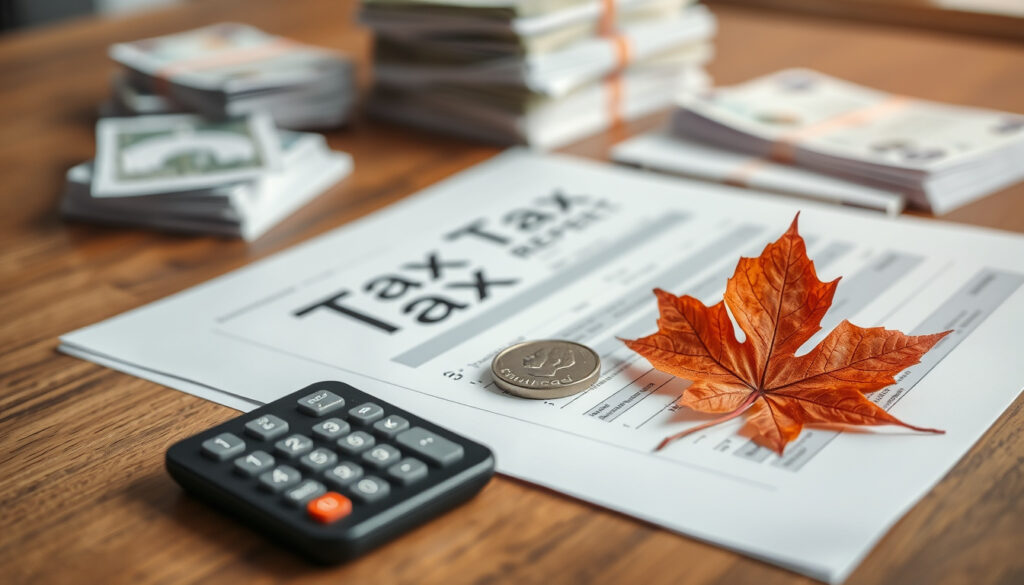
How Much Is Tax in Ontario? 2025 Rates & Examples
If you’re living in Ontario or planning to move here, the first question that often comes to mind is just how much of your hard-earned money goes to taxes. Between the 13% HST on almost everything you buy and a progressive income tax system that combines federal and provincial rates, the answer isn’t as simple as a single number.
Ontario HST rate: 13% ·
Ontario lowest marginal tax rate: 5.05% ·
Ontario highest marginal tax rate: 13.16% ·
Ontario basic personal amount (2025): $12,747 ·
Combined federal + Ontario top rate: 53.53%
Quick snapshot
- Rate: 13% (8% provincial + 5% federal) (WOWA.ca (Canadian real estate calculator))
- Applies to most goods and services (Retail Council of Canada (retail industry association))
- Exemptions: groceries, rent, prescription drugs (Canada Revenue Agency (government tax authority))
- Progressive rates from 5.05% to 13.16% (Wealthsimple (financial platform))
- Combined federal/Ontario up to 53.53% (PwC Tax Summaries (global accounting firm))
- Annual adjustments for inflation (Canada Revenue Agency (government tax authority))
- $70k → ~$54,300 (TurboTax Canada (tax software))
- $100k → ~$72,000 (TurboTax Canada (tax software))
- $200k → ~$115,000 (TurboTax Canada (tax software))
- Official CRA calculator (government tax authority)
- TurboTax Ontario calculator (tax software)
- Wealthsimple tool (financial platform)
Five key data points tell the story of Ontario taxation in 2025. Here they are at a glance:
| Tax Factor | Value |
|---|---|
| HST Rate | 13% (WOWA.ca) |
| First Ontario Bracket (up to $52,886) | 5.05% (Wealthsimple) |
| Top Ontario Bracket (over $220,000) | 12.16% (Fidelity Investments) |
| Combined Top Marginal Rate | 53.53% (PwC Tax Summaries) |
| Basic Personal Amount (Ontario 2025) | $12,747 (TurboTax Canada) |
| Federal Lowest Rate (2025) | 14.5% (PwC Tax Summaries) |
Is it 13% tax in Ontario?
What is the Harmonized Sales Tax (HST) in Ontario?
- Ontario’s HST is a single 13% rate – the sum of an 8% provincial component and a 5% federal component (WOWA.ca (Canadian real estate calculator)).
- It applies to most goods and services sold in the province, from electronics to restaurant meals (Retail Council of Canada (retail industry association)).
Which goods and services are exempt from HST?
- Basic groceries, prescription drugs, residential rent, and certain medical devices are zero-rated or exempt (Canada Revenue Agency (government tax authority)).
- Financial services, childcare, and educational services also generally escape HST.
For anyone making a major purchase like a car or renovation, the 13% HST adds a big lump – on a $50,000 vehicle that’s $6,500 in tax alone. Budget for it upfront.
How much tax do I pay on my income in Ontario?
How are federal and Ontario income taxes combined?
- Canada uses a progressive system: you pay separate federal and Ontario taxes based on your taxable income (Canada Revenue Agency (government tax authority)).
- Federal brackets for 2025: 14.5% up to $57,375; 20.5% to $114,750; 26% to $177,882; 29% to $253,414; 33% above that (PwC Tax Summaries (global accounting firm)).
- Ontario brackets: 5.05% up to $52,886; 9.15% to $105,775; 11.16% to $150,000; 12.16% to $220,000; 13.16% above $220,000 (Wealthsimple (financial platform)).
What is the Ontario basic personal amount?
- In 2025, the Ontario basic personal amount is $12,747 – the first chunk of income you earn is tax-free at the provincial level (TurboTax Canada (tax software)).
- The federal basic personal amount is higher, around $15,705 for 2025. Combined, they shelter roughly $28,452 from tax.
The implication: income between $0 and about $28,452 incurs zero federal and Ontario income tax before accounting for credits.
How much is $70,000 after tax in Ontario?
What deductions reduce gross income?
- CPP contributions (2025: ~$3,500) and EI premiums (~$1,000) are mandatory deductions from employment income (TurboTax Canada (tax software)).
- After these, federal and Ontario income tax is calculated on your taxable income.
What is the take-home pay for $70,000 in Ontario?
- Using 2025 brackets: federal tax ~$7,500, Ontario tax ~$3,700, plus CPP/EI of ~$4,500 – total deductions ~$15,700.
- Net income after tax: approximately $54,300 (TurboTax Canada (tax software)).
- Actual amounts vary with credits and deductions (e.g., RRSP contributions, tuition).
A $70,000 earner loses roughly 22% of gross income to taxes and deductions. That’s about $15,700 not available for rent, savings, or spending.
How much is $100,000 after taxes in Ontario?
What tax bracket does $100,000 fall into?
- At $100,000, you land in the 11.16% Ontario bracket and the 26% federal bracket (because federal 26% starts at $114,750, so the marginal rate on the top portion is 26% federal + 11.16% Ontario = 37.16% (Fidelity Investments (investment management)).
- Ontario surtax applies once provincial tax exceeds ~$5,000, adding about 20% to the Ontario tax bill.
How does the Ontario surtax affect high incomes?
- After the surtax, the effective Ontario rate on income above $105,775 can climb to 11.16% plus a surcharge of roughly 20% of the Ontario tax itself (TaxTips.ca (Canadian tax reference)).
- For $100,000, the total tax (federal + Ontario + surtax + CPP/EI) comes to about $28,000, leaving ~$72,000 take-home (TurboTax Canada (tax software)).
The Ontario surtax kicks in well before you hit the top bracket, meaning even mid-income earners feel a disproportionate provincial bite compared to lower brackets.
How much tax do you pay on $200,000 in Canada?
What is the top marginal rate in Ontario?
- At $200,000, you are in the top Ontario bracket (12.16%) and the federal 29% bracket (just below the 33% threshold). Combined marginal rate: approximately 53.53% when including the Ontario surtax and federal surtax (PwC Tax Summaries (global accounting firm)).
- That means every additional dollar earned above $220,000 (when the 33% federal bracket hits) faces a combined rate of 46.16% federal+provincial, plus surtaxes.
How do deductions impact high incomes?
- CPP and EI are capped: maximum CPP contribution ~$4,000, EI ~$1,077 for 2025.
- After all deductions and taxes, an Ontario resident earning $200,000 takes home approximately $115,000 (TurboTax Canada (tax software)).
- High earners can reduce taxable income through RRSP contributions, capital gains exemptions, and other strategies.
Four salary levels, one pattern: the more you earn, the higher the effective tax rate, but the biggest jump happens between $70k and $100k. Here’s the side-by-side:
| Gross Income | Federal Tax | Ontario Tax | CPP + EI | Total Deductions | Net Income After Tax |
|---|---|---|---|---|---|
| $70,000 | $7,500 | $3,700 | $4,500 | $15,700 | $54,300 (TurboTax Canada) |
| $100,000 | $17,058 | $6,983 | $4,500 | $28,541 | $71,459 (TurboTax Canada) |
| $150,000 | $32,009 | $13,150 | $4,500 | $49,659 | $100,341 (TurboTax Canada) |
| $200,000 | $42,909 | $18,524 | $4,500 | $65,933 | $134,067 (TurboTax Canada) |
The pattern: moving from $70k to $100k increases your tax bill by about 80% despite only a 43% income gain – a reminder of how quickly progressive brackets kick in.
What we know and what’s still unclear
Confirmed facts
- Ontario HST is 13% as of 2025 (WOWA.ca).
- 2025 Ontario income tax brackets are published by the CRA (Canada Revenue Agency).
- Basic personal amount for Ontario 2025 is $12,747 (TurboTax Canada).
What remains unclear
- Exact 2026 brackets may be adjusted – rates are indexed annually and published in January (Canada Revenue Agency).
- Individual tax credits and deductions vary per person, so final liability can differ significantly from estimates.
- Potential changes to federal or provincial rates after the 2025 election could alter the picture.
Expert perspectives
Provinces and territories determine their own income tax rates, while the federal government sets federal income tax rates.
Canada Revenue Agency (government tax authority)
An Ontario after-tax income calculation starts with all income sources, then applies federal tax, then provincial tax, then subtracts CPP and EI.
TurboTax Canada (tax software)
For Ontario residents, the implication is clear: understanding both HST and income tax is essential for accurate budgeting. Rely on official calculators and your own credits to get a precise number – one-size-fits-all estimates can miss thousands in savings.
For a detailed breakdown of Ontario tax rates and brackets, see Ontario tax rates and brackets.
Frequently asked questions
What is the Ontario basic personal amount?
The Ontario basic personal amount for 2025 is $12,747. You do not pay Ontario provincial tax on the first $12,747 of taxable income (TurboTax Canada).
How do CPP and EI deductions affect my take-home pay?
CPP (Canada Pension Plan) and EI (Employment Insurance) are mandatory deductions from most employment income. In 2025, maximum CPP contribution is about $4,000 and EI premium is about $1,077. These reduce your gross pay before income tax is calculated (TurboTax Canada).
Are there tax credits available for low-income earners in Ontario?
Yes. The Ontario Trillium Benefit, Ontario Sales Tax Credit, and Ontario Energy and Property Tax Credit can reduce the tax burden for low- to moderate-income residents. Eligibility depends on income and filing status.
How often do Ontario tax brackets change?
Ontario tax brackets are indexed annually to inflation. Updates are typically published by the Canada Revenue Agency in January of each tax year (Canada Revenue Agency).
What is the difference between federal and provincial tax in Ontario?
Federal tax is levied by the Government of Canada using its own progressive brackets and rates. Provincial tax is levied by the Province of Ontario using separate brackets. Both are combined on your tax return to determine your total income tax liability (Canada Revenue Agency).
Do I need to file a tax return if I earn less than the basic amount?
Even if your income is below the basic personal amount, you may still need to file a return to receive refundable credits (e.g., GST/HST credit, Ontario Trillium Benefit) or to report income from other sources. Non-filers could miss out on payments they are entitled to.
Is the Ontario HST included in the price or added at checkout?
In most retail settings, HST is included in the posted price. However, some services (e.g., professional fees, hotel stays) may advertise prices before tax. Always confirm whether the displayed price includes HST (Retail Council of Canada).
More related posts
 108 USD to CAD – Live Conversion and Best Rates
 Spousal Open Work Permit – Eligibility Guide 2025
 Montreal Canadiens Standings 2026 | NHL Ranking & Playoffs
 Toronto Maple Leafs Rumors – Latest Trade Buzz and Management News
 Toyo Open Country AT3 Tire Review: Is It a Good All-Terrain?
 Your Lie in April: Age Rating, Plot, and Why It’s So Sad
 Tottenham vs Man City Standings: H2H Record & League Table