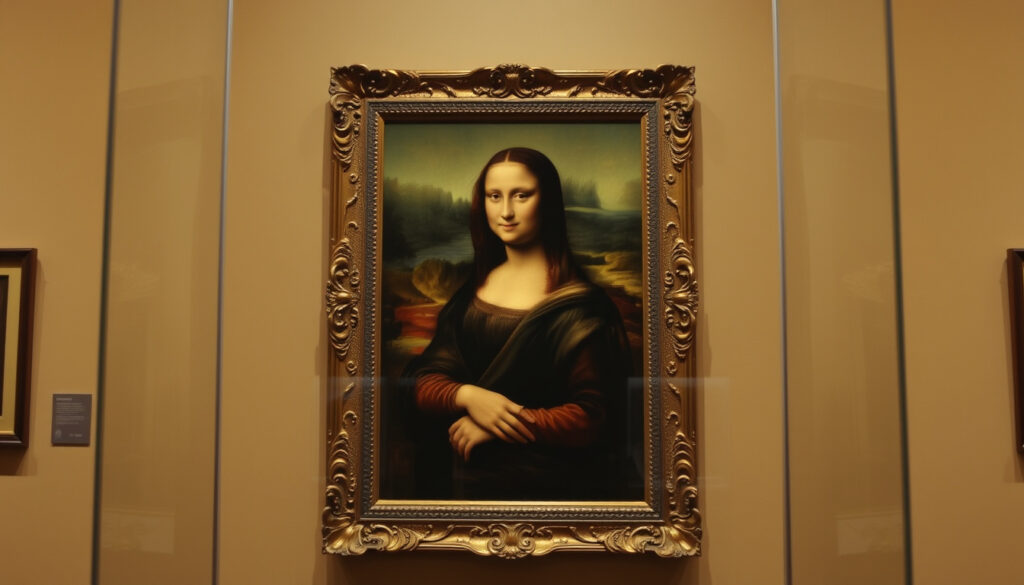
Mona Lisa: Why It’s So Famous, Worth, Facts, and History
Walk through the Louvre’s Salle des États and you’ll see a crowd three or four deep, all jostling for a glimpse of a small woman behind bulletproof glass. The Mona Lisa has been the world’s most recognized painting for over a century, but her path to that status is a story of theft, marketing, and a master’s brushwork that still baffles viewers.
Artist: Leonardo da Vinci · Year painted: 1503–1519 · Medium: Oil on poplar panel · Dimensions: 77 cm × 53 cm · Location: Louvre Museum, Paris · Estimated value: Over $800 million (uninsured)
Quick snapshot
- Leonardo da Vinci (1452–1519) (Wikipedia, general encyclopedia)
- Italian Renaissance polymath (Wikipedia, general encyclopedia)
- Also painted The Last Supper, Vitruvian Man (Wikipedia, general encyclopedia)
- Louvre Museum, Paris (Study.com, educational resource)
- Salle des États (Room 711) (Study.com, educational resource)
- Behind bulletproof glass, climate controlled (Study.com, educational resource)
- 1911 theft made international headlines (History Hit, historical publication)
- Leonardo’s sfumato technique creates enigmatic smile (History Hit, historical publication)
- Countless reproductions and pop culture appearances (History Hit, historical publication)
- Not sold; considered priceless (Study.com, educational resource)
- Insurance valuation ~$800 million (Study.com, educational resource)
- Most expensive sold: Salvator Mundi (~$450 million) (Study.com, educational resource)
Six key facts at a glance – from the artist who created it to the staggering insurance value that places it in a category all its own.
| Attribute | Value |
|---|---|
| Artist | Leonardo da Vinci |
| Year painted | 1503–1519 |
| Medium | Oil on poplar panel |
| Dimensions | 77 cm × 53 cm |
| Current location | Louvre Museum, Paris |
| Estimated value | Over $800 million (uninsured) |
Why exactly is the Mona Lisa so famous?
Theft of 1911 and media sensation
- The Mona Lisa’s fame exploded after it was stolen from the Louvre on 21 August 1911 (History Hit, historical publication).
- The thief, Vincenzo Peruggia, hid in a broom closet and left with the painting under his coat (Wikipedia, general encyclopedia).
- The theft dominated headlines for years and turned the painting into a household name (History Hit, historical publication).
A single crime turned a respected Renaissance portrait into a global obsession. Before 1911, the Mona Lisa was admired by art lovers; after, it was known to everyone.
The implication: without the theft, the Mona Lisa might still be a masterpiece – but not the cultural shorthand it has become.
Leonardo’s innovative technique
- Leonardo used sfumato – a technique of layering thin glazes to create soft transitions – to give the smile its lifelike ambiguity (Wikipedia, general encyclopedia).
- This technique required extreme patience and contributed to the painting’s long creation period.
Cultural references and pop culture
- The Mona Lisa has been referenced in countless films, songs, and advertisements – from The Da Vinci Code to Nat King Cole’s “Mona Lisa.”
- It is the most visited painting in the world, attracting about 20,000 people per day (Study.com, educational resource).
The pattern: each reproduction, each parody, each selfie taken in front of the glass case reinforces the painting’s spot at the center of popular imagination.
How much is the Mona Lisa painting worth?
Why it is considered priceless
- The Mona Lisa has never been sold and is held by the French state as part of the national collection (Wikipedia, general encyclopedia).
- It is uninsured and any valuation is purely hypothetical (Wikipedia, general encyclopedia).
Insurance and valuation estimates
- In 1962, the Mona Lisa was assessed at US$100 million for insurance purposes – equivalent to about US$1 billion in 2023 (Wikipedia, general encyclopedia).
- A 2020 valuation placed it at around US$860 million (Study.com, educational resource).
Comparison with most expensive sold paintings
- The most expensive painting ever sold at auction is Salvator Mundi, attributed to Leonardo da Vinci, which sold for US$450 million in 2017.
- If the Mona Lisa ever were sold, experts believe it would far exceed that figure – perhaps surpassing US$1 billion.
The painting is both the most expensive ever insured and literally priceless – because it can never be sold. Its value lives in the cultural economy, not the art market.
What is the real story behind the Mona Lisa?
The identity of the sitter
- The sitter is widely believed to be Lisa Gherardini, wife of Francesco del Giocondo (Wikipedia, general encyclopedia).
- This identification comes from Giorgio Vasari’s 1550 biography of Leonardo (Wikipedia, general encyclopedia).
Commission and creation
- The painting was commissioned by Francesco del Giocondo around 1503 (ArtCurious Podcast, art history series).
- Leonardo never delivered it to the family; he kept it with him until his death in 1519 (ArtCurious Podcast, art history series).
History after Leonardo’s death
- King Francis I of France acquired the painting; it entered the French royal collection and later the Louvre (Study.com, educational resource).
- During World War II it was moved for protection from bombs and theft (Study.com, educational resource).
The pattern: from a private commission to a royal treasure to a global icon – each chapter added layers of fame.
What are 5 facts about the Mona Lisa?
Fact 1: Dimensions and medium
- The painting is small: 77 cm × 53 cm, oil on poplar panel (Wikipedia, general encyclopedia).
Fact 2: The missing eyebrows
- Eyebrows are absent, possibly due to overcleaning or Leonardo’s deliberate choice (Wikipedia, general encyclopedia).
Fact 3: Multiple layers and reworkings
- X‑rays reveal at least three versions of the portrait underneath the visible layer (Wikipedia, general encyclopedia).
Fact 4: The glass case and bulletproof protection
- It is displayed behind bulletproof glass in a climate‑controlled case (Study.com, educational resource).
Fact 5: Daily visitor count
- Approximately 20,000 people visit the Mona Lisa every day (Study.com, educational resource).
The catch: five facts, five reasons the painting commands unparalleled attention – not despite its size, but because of the mystery packed into that small panel.
Why did it take 14 years to paint the Mona Lisa?
Leonardo’s perfectionism and slow working style
- Leonardo worked on the painting from 1503 to 1519, intermittently (ArtCurious Podcast, art history series).
- He was known to work slowly, often leaving works unfinished (ArtCurious Podcast, art history series).
Continuous revisions and layered technique
- The sfumato technique required many thin glaze layers built over time (Wikipedia, general encyclopedia).
- X‑rays show he changed the composition repeatedly while painting (Wikipedia, general encyclopedia).
Other commissions and distractions
- Leonardo juggled multiple projects, including engineering work for the Duke of Milan and studies in anatomy.
- He carried the painting with him when he moved to France in 1517 and continued working on it until his death (ArtCurious Podcast, art history series).
Key events in the Mona Lisa’s history
- 1503–1519: Leonardo da Vinci paints the Mona Lisa, continues to revise it (ArtCurious Podcast, art history series)
- 1517: Leonardo arrives in France with the painting; King Francis I acquires it (Study.com, educational resource)
- 1550: Giorgio Vasari publishes biography mentioning the painting; first written description (Wikipedia, general encyclopedia)
- 1797: Painting moves to the Louvre after French Revolution (Study.com, educational resource)
- 1911: Mona Lisa is stolen from the Louvre; becomes worldwide sensation (History Hit, historical publication)
- 1913: Painting recovered in Florence, Italy; returned to Louvre (History Hit, historical publication)
- 1962: Exhibited in the United States (National Gallery, Washington; Metropolitan Museum, New York) (Study.com, educational resource)
- 1974: Exhibited in Tokyo and Moscow
- 2005: Moved to a new, specially designed room (Salle des États) with enhanced security
- 2021: Post‑pandemic increase in visitors; Louvre continues to manage crowds
Clarity: confirmed facts and what’s unclear
Confirmed facts
- Painted by Leonardo da Vinci between 1503 and 1519 (Wikipedia, general encyclopedia)
- Held in the Louvre Museum, Paris (Study.com, educational resource)
- Stolen in 1911 and recovered in 1913 (History Hit, historical publication)
- Depicts a woman with an enigmatic smile, using sfumato technique (Wikipedia, general encyclopedia)
What’s unclear
- Exact identity of the sitter (most likely Lisa Gherardini, but not proven conclusively)
- Why the painting lacks visible eyebrows and eyelashes (Wikipedia, general encyclopedia)
- Precise original colors due to varnish aging and past restorations
- Whether Leonardo considered it finished
Voices on the Mona Lisa
“so pleasing that it seems divine rather than human”
Giorgio Vasari, 16th‑century art historian (Wikipedia, general encyclopedia)
“the most visited painting in the world”
Louvre Museum official statement (Study.com, educational resource)
“a cultural icon that transcends art”
Ken Burns, documentary filmmaker
For museum visitors planning to see the Mona Lisa in person, the takeaway is simple: arrive early, be patient, and remember that the real treasure lies not in the hype but in the quiet mastery of Leonardo’s brushwork. The canvas waits behind glass; the story behind it is what keeps the crowd coming.
- Want to explore other great museums? Check out Musée des Beaux-Arts: Exhibitions, Hours & City Guides – a guide to another world‑class collection.
The painting’s fame was further amplified by the 1911 theft of the Mona Lisa, which made headlines worldwide.
Frequently asked questions
Is the Mona Lisa the most expensive painting ever sold?
No. It has never been sold and is considered priceless. The most expensive painting ever sold is Salvator Mundi at US$450 million.
How was the Mona Lisa stolen from the Louvre?
On 21 August 1911, employee Vincenzo Peruggia hid in a broom closet, removed the painting from its frame, and walked out with it under his coat (History Hit, historical publication).
Why is the Mona Lisa’s smile so famous?
Leonardo used the sfumato technique to blend colours and create a soft, ambiguous expression that seems to change depending on lighting and angle (Wikipedia, general encyclopedia).
What does sfumato mean in art?
Sfumato (from Italian fumo “smoke”) is a painting technique that produces soft, hazy transitions between colours and tones, without sharp outlines (Wikipedia, general encyclopedia).
Are there any copies of the Mona Lisa?
Yes. The most famous copy is the Prado Mona Lisa, painted in Leonardo’s workshop. Many other copies exist from the 16th and 17th centuries.
How many people visit the Mona Lisa each year?
About 20,000 people per day, or roughly 7 million per year, make it the most visited painting on earth (Study.com, educational resource).
Why is the Mona Lisa behind bulletproof glass?
After a series of vandalism attempts and to protect it from theft and environmental damage, the painting is encased in a climate‑controlled, bulletproof glass box (Study.com, educational resource).
What is the value of the Mona Lisa if it were sold?
Experts estimate it would exceed US$1 billion, but since it belongs to the French state, a sale is extremely unlikely (Wikipedia, general encyclopedia).
More related posts
 Kirby Dach: Contract, Salary, Injury, Trade & Career Stats
 How Much Is Tax in Ontario? 2025 Rates & Examples
 Ninja Ice Cream Maker Review: Is It Worth Buying? (2025)
 Finn Wolfhard LGBTQ roles: Sexuality, Relationships & Facts
 Bass Pro Shop Canada: Locations, Ownership, and Facts
 Tylor Chase Movies and TV Shows: Complete Filmography
 Phil Mickelson Golfer: 2024 News & Controversies
 AL East Standings 2025 – Blue Jays Win Division Title