We Didn’t Start the Fire – Billy Joel’s Historical Lyrics Explained
The Historical Torrent Inside a Pop Hit
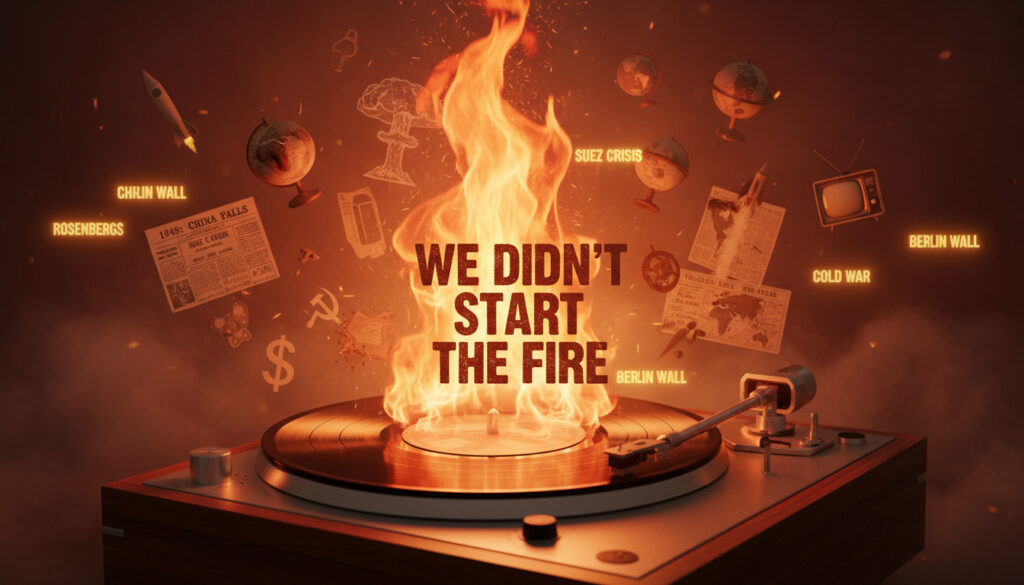
When Billy Joel released “We Didn’t Start the Fire” in September 1989, he distilled forty years of headlines into four and a half minutes of staccato verses. The song became an immediate cultural phenomenon, reaching number one on the Billboard Hot 100 by November and remaining there for two weeks. What distinguished the track from other chart-toppers was its relentless encyclopedic scope, referencing 118 distinct historical events, figures, and cultural touchstones spanning from 1949 to 1989.
Joel composed the lyrics after a conversation with a younger friend who claimed that the 1980s represented uniquely stressful times. The songwriter countered that his own generation had lived through hydrogen bomb tests, assassination attempts, and proxy wars. The resulting track functions simultaneously as baby boomer defense mechanism, Cold War anxiety release valve, and unlikely educational tool.
Reference Grid
The song operates as a compressed historical database. Key metrics illuminate its scope:
- Temporal Range: Covers events from Joel’s birth year (1949) through the song’s recording (1989)
- Structural Approach: Each verse spans roughly one decade, accelerating as chronology progresses
- Chart Performance: Reached #1 in US, Canada, UK, and Australia
- Grammy Recognition: Nominated for Record of the Year, Song of the Year, and Best Pop Vocal Performance, Male in 1990
Cultural Insights
The track’s enduring relevance stems from its documentary function. For listeners born after 1989, the lyrics serve as a fragmented textbook of twentieth-century anxieties. Historical analysis reveals that Joel selected references not solely by significance but by syllabic fit, creating a rhythm-driven narrative where the Gang of Four follows heavy metal suicide.
The generational defense embedded in the chorus—asserting that historical turmoil predates any single cohort—resonates differently across age groups. Older listeners recognize the litany of crises as lived experience, while younger audiences encounter names like Syngman Rhee or Doris Day as archaeological artifacts requiring digital excavation.
Chronological Index
| Year | Cultural/Political References |
|---|---|
| 1949 | Harry Truman, Doris Day, Red China, Johnny Ray |
| 1950s | South Pacific, Walter Winchell, Joe DiMaggio, Joseph Stalin |
| 1960s | U-2 spy plane, Malcolm X, British Beatlemania, Bay of Pigs |
| 1970s | Watergate, punk rock, Begin and Reagan, Palestine |
| 1980s | Foreign debts, homeless vets, AIDS, crack, Bernie Goetz |
Specific Details and Obscurities
The song’s lexical density creates moments of historical whiplash. Joel pairs the Suez Crisis with Buddy Holly’s fatal plane crash, treating geopolitical catastrophe and rock mythology with equal rhythmic weight. Some references carry specific personal weight—”Roy Cohn” alludes to the McCarthy-era prosecutor who later mentored Donald Trump, while “hypodermic needles on the shore” documents 1988 environmental contamination in New York.
Canadian audiences particularly gravitated toward the track’s North American cultural references, cementing Joel’s status in 1980s continental music history. The song’s mention of “Rock and Roller Cola Wars” encapsulates the commercialization of counterculture that defined the decade’s end.
Release Timeline
- September 1989: Single released as lead track from Storm Front album
- October 1989: Music video premieres featuring rapid-fire imagery synchronized to lyrics
- November 18, 1989: Reaches #1 on Billboard Hot 100
- January 1990: Grammy nominations announced
- 1990: Global chart presence expands throughout Commonwealth markets
Clarifying Misconceptions
Contrary to popular belief, Joel did not intend the song as a comprehensive historical record. He selected events that scanned metrically rather than those carrying maximum historical weight. The line about “we didn’t start the fire” serves less as absolution and more as acknowledgment—recognizing that historical continuity places each generation within inherited circumstances.
Additionally, while often categorized as pure rock, the track employs a spoken-word delivery over a D major progression, creating a unique hybrid of folk narration and pop instrumentation. The beat never deviates from its driving eighth-note pulse, mirroring the unstoppable march of current events.
Musical and Lyrical Analysis
The composition has drawn criticism for its lack of melodic development in verses, yet this structural choice serves the content. Joel delivers the lyrics in near-monotone recitation, allowing the words themselves to carry rhythmic weight. Only in the chorus does the melody fully expand, offering the ear relief while reinforcing the central thematic argument.
Historians note the song’s accuracy regarding chronology, though some juxtapositions create false equivalencies between entertainment news and geopolitical crises. The compression of decades into seconds reflects the accelerating information density of the late twentieth century, prefiguring the internet’s information bombardment years before broadband proliferation.
Artist Perspectives
“It’s a nightmare to perform. I tried to write it in a way that would be hard to sing, and I succeeded. By the end of the verses, I’m practically hyperventilating.”
— Billy Joel, regarding live performance challenges
“History was my worst subject in school. The irony is not lost on me that I wrote a history song.”
— Joel on the educational legacy of the track
Legacy Summary
“We Didn’t Start the Fire” remains Joel’s fastest-selling single, yet occupies complicated space in his catalog. Critics initially dismissed it as gimmicky, though decades of classroom deployment and cultural referencing have elevated its status as a period document. The song functions now as a generational boundary marker—those who recognize every reference without search engine assistance likely experienced the latter half of the twentieth century as sentient adults.
The track’s abrupt ending in 1989 leaves the historical narrative unresolved, suggesting continuity rather than conclusion. Subsequent decades have spawned numerous fan attempts at “Verses 7 and 8,” though Joel himself has resisted extending the chronology, noting that the song belongs to its specific historical moment—the fragile optimism of 1989 before geopolitical realignment fully reshaped the global order.
Frequently Asked Questions
Did Billy Joel actually like history?
Joel has repeatedly stated that history was his poorest academic subject. The song emerged not from scholarly interest but from conversational impulse—the desire to demonstrate that contemporary anxieties fit within larger historical patterns of crisis.
How many historical events appear in the lyrics?
The song references approximately 118 specific events, people, and cultural phenomena. The exact count varies depending on whether compound references (like “British Beatlemania”) are counted as single or multiple entries.
Why does the song stop at 1989?
Joel ceased writing when the song reached contemporary time. He has explained that adding later decades would require constant updating, and the 1989 endpoint captures a specific historical inflection point before the Soviet Union’s dissolution fundamentally altered the Cold War references dominating the lyrics.
Was the song really inspired by someone younger criticizing the 1980s?
Yes. Joel stated that Sean Lennon, then entering his twenties, remarked that the 1980s must represent the worst possible time to live through. Joel responded by listing headlines from his own youth, leading to the realization that historical stress accumulates across generations.
More related posts
 How Old is the Earth? 4.54 Billion Years Explained
 Environment Canada Winter Advisory: 2026 Colour-Coded Alerts
 Normal Temperature for Adult: Ranges, Fever Thresholds & Concerns
 Convert cm to Feet: The Easy Height Conversion Guide
 Cristiano Ronaldo: Net Worth, Retirement & Family Guide
 Monica Lewinsky: Biography, Scandal, and Life Today
 Wealth imple Line of Credit: Rate , Ri k , How to Apply
 Philippine Peso to Canadian Dollar: Live CAD to PHP Rate